You are currently browsing dbreecker’s articles.
President Obama, in his first State of the Union address, told us that other countries are making the investments needed to seize the opportunities present in meeting the world’s grand challenges, and that the U.S. risks being left behind. He’s right.
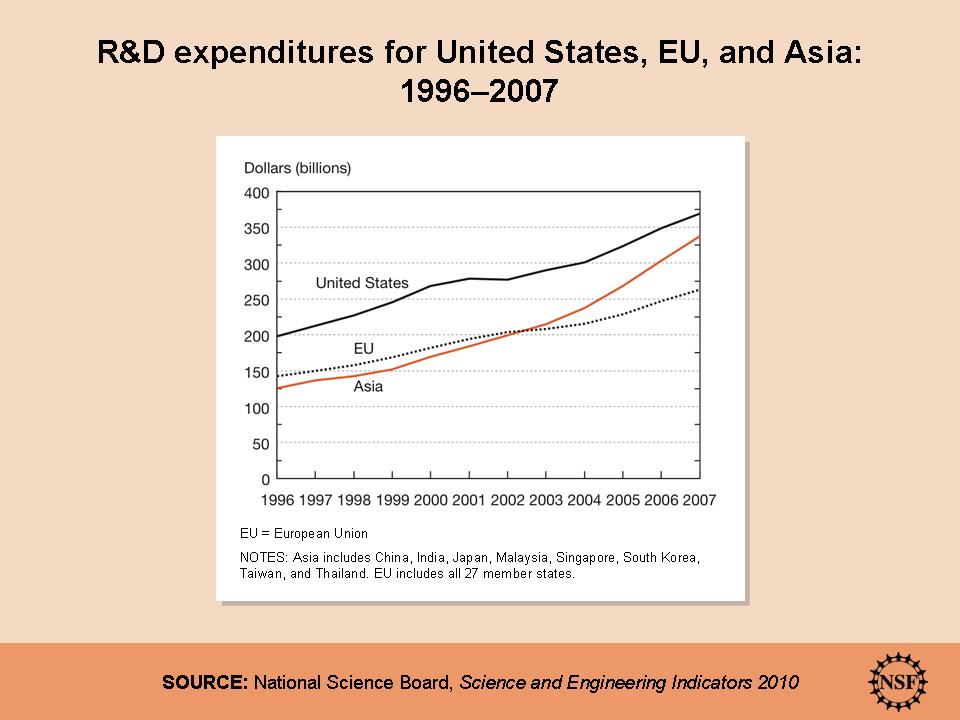
The National Science Board’s biennial Science & Engineering Indicators suggests that as early as the 2012 edition, the U.S. will no longer lead the world in total R&D expenditures – unless corrective action is taken (graph here). And Senator Jeff Bingaman, who chairs the Senate Committee on Energy and Natural Resources, recently told a Senate hearing that “…our investments in new energy technologies, and the science underlying them, have been surprisingly deficient over the last 20 years…. our national R&D investments in medicine and biotechnology, as a percentage of sales, are about 40 times greater than our research and development investments in energy.” Read the rest of this entry »
Over the past few weeks, a chorus of voices from around the world has started to sound like a warning buzzer for U.S. competitive and innovation strategy. Thomas L. Friedman, writing in the New York Times, reported back from Denmark that that country has succeeded in levying a susbstantial energy tax (deemed politically impossible here), and applying the proceeds to renewable energy innovation, development, and deployment.
Bruce Nussbaum from Business Week completed a tour of Asia, impressed everywhere he visited with the attention being paid to design as a critical innovation element at all levels (including national policy), leading to what he called “Designomics” in his speech to the Design Korea 2009 International Conference: “The global economy is emerging from the Great Recession… with a very different shape, a very different trajectory and a very different set of growth engines. Read the rest of this entry »
The good news in our prior post is sadly updated to reflect new guidance, released by DOE shortly before the submission deadline for the Energy Efficiency and Conservation Block Grant Level 2 application, regarding applicant eligibility criteria. This new information disqualified the Sonoma County Transportation Agency, which was to have served as the lead applicant for the Applied Solutions Coalition partnership proposal (see prior post here), including SFIP.
However, ASC and its federal experts fully intend to continue seeking funding for the partnershp’s projects, including SFIP’s energy program as previously detailed. Stay tuned for more information.
This post is updated as of December 14. DOE released additional guidance on applicant eligibility on Friday, December 11, just prior to the submission deadline, which unfortunately rendered the lead applicant for this partnership ineligible. See the new post here for additional information.
SFIP and its energy/climate program have been invited by the Applied Solutions Coalition (ASC) to join in a multi-partner grant application to DOE, through the department’s Energy Efficiency and Conservation Block Grant program under the American Reinvestment and Recovery Act (ARRA). Sonoma County, California will act as the lead applicant, along with partners Los Alamos National Laboratory, New Mexico; Story County, Iowa; Buncombe County Schools, North Carolina; Sonoma Mountain Village; Applied Solutions Coalition; and SFIP. The total request among all partners is approximately $5 million. Read the rest of this entry »
SFIP is pleased to welcome its new alliance partner, the Business Innovation Factory. Based in Providence, RI, BIF is a national leader in systemic and business process innovation, hosts a top-rated annual thought leaders summit, and is focused on the elder care, energy, and education areas. Together, BIF and SFIP plan to launch the Code Green Energy Innovation Laboratory, a user-centered residential consumer lab for new energy products and systems.
Here’s some fascinating trans-disciplinary and highly innovative work in the architectural design field (with some very cool pictures, too):
HOK, one of the world’s largest architectural firms… formed an exclusive alliance with the Biomimicry Guild, a Montana-based consulting organization that pairs consulting biologists with designers, seating architects and ecologists together at the drawing table.
http://harvardmagazine.com/2009/09/architecture-imitates-life
In keeping with SFIP’s programmatic focus on the energy/climate challenge (see Projects page for more), this promises to be an important addition to the literature:
MIT Press releases Holdren, Schelling, and Bonvillian essays from “Energy for Change: Creating Climate Solutions,” the Fall issue of Innovations journal
In conjunction with the clean energy address that President Obama is delivering at MIT today, MIT Press is releasing essays from the soon to be published fall special issue of Innovations journal on energy and climate solution. The pre-released essays are authored by White House Science Adviser John Holdren, 2005 Nobel Laureate in Economics Thomas Schelling, and the Director of MIT’s Washington office, William Bonvillian.
In his introduction to the special issue, Holdren states that the forthcoming publication is “as thorough a survey of energy and climate solutions as has yet been compiled.” Of the climate challenge, he writes:
“Without energy, there is no economy. Without climate, there is no environment. Without economy and environment, there is no material well-being, no civil society, no personal or national security. The overriding problem associated with these realities, of course, is that the world has long been getting most of the energy its economies need from fossil fuels whose emissions are imperiling the climate that its environment needs.” Read the rest of this entry »
SFIP is a proud sponsor of the October 12-14 Applied Solutions Coalition Conference in Santa Fe.
From the ASC Conference website:
The main goal of the Applied Solutions Coalition is to develop a mechanism for design and funding of large, integrated renewable energy infrastructure projects. Projects should incorporate most, if not all, of the four main legs of sustainable infrastructure – transportation, renewable energy, energy and water conservation and greenhouse gas emissions reduction. Incorporating multiple aspects of sustainable infrastructure allows the technologies to build upon each other’s strengths and leverage each effect for maximum impact.
Traditional methods of infrastructure funding do not take into account the additive resource reduction benefits of such integrated projects nor do they take into account the size of funding necessary to implement such large and relatively new ideas. Capital markets and Capital Hill are not familiar with this way of thinking yet so it is the goal of Applied Solutions Coalition to forge a path to bring these new project ideas to fruition.
Read more HERE
Scroll through participating projects HERE
Clint Wilder riffs on the Clinton Global Initiative, Paul Krugman and the absence of heroic innovation in the U.S.
Read his Clean Edge column HERE






 SFIP | Santa Fe Innovation Park